Mostrar mensagens com a etiqueta guerras. Mostrar todas as mensagens

segunda-feira

Perdas no Iraque

Uma resposta de Yanar Mohammed, activista dos direitos das mulheres iraquianas, numa entrevista no Truthdig:

(...) o mito da democracia já matou meio milhão de iraquianos, o que seria perdoável se nos tivesse sido dada a real democracia, na qual as pessoas são representadas segundo as suas filiações políticas, o seu entendimento económico ou as suas sensibilidades em justiça social. Contudo, os iraquianos são representados segundo a sua religião e etnia. É como se a Administração dos EUA estivesse a tentar dizer ao mundo que os iraquianos não têm o direito ao entendimento político ou à actividade política. A fórmula que nos foi dada é um insulto a uma parte do mundo onde a actividade política é bastante dinâmica e onde existe toda uma gama de ofertas políticas - ao início da guerra inscreveram-se milhares de partidos políticos. E todos eles queriam competir, ou digamos, correr para a democracia; mas a quem foi dado o poder, quem foi apoiado? Na maior parte os grupos religiosos e os grupos étnicos. E os grupos de mulheres? A Administração americana não estava realmente interessada em falar com grupos de mulheres, digamos, livres. Preferiram trazer elementos decorativos para o parlamento, pessoas que parecem mulheres, mas que votam numa constituição que é contra as mulheres. A constituição, neste momento, impôs-nos a lei da Sharia, quando, antes da guerra, tinhamos uma constituição secular que respeitava os direitos das mulheres. Portanto, algo mais perdido nesta guerra.(...)

Tradução minha (o itálico no original)

quinta-feira

Iraque: 655 000

Uma equipa de epidemiologistas americanos e iraquianos estimou que, desde que as forças de coalição invadiram o Iraque, morreram mais 655 mil pessoas do que se a invasão não tivesse ocorrido. Destas, 601 mil pessoas morreram de causas violentas.

Esta estimativa foi feita com base num inquérito feito por oito médicos iraquianos. Eles visitaram 1849 casas seleccionadas ao acaso, que tinham um agregado familiar de, em média, sete membros. Das 629 mortes reportadas durante o inquérito, 87% aconteceram depois da invasão. 56% das mortes violentas deveram-se a ferimentos provocados por tiros, 14% devido a bombas em carros e outras explosões. Das mortes violentas ocorridas depois da invasão, 31% foram causadas por forças de coalição ou ataques aéreos.

Fonte da informação neste poste: Study Claims Iraq's 'Excess' Death Toll Has Reached 655,000, Washington Post.

sexta-feira

10-12 anos

Ontem discutia-se a guerra no Iraque e um tipo disse que os EUA teriam, provavelmente, de ficar mais 10-12 anos. Que no', em que no' esta gente se meteu. E' o que da' nao me pedirem conselho.

sexta-feira

Hope?

Dear Friends,

As the awful civilian death toll rises above 1000 in Lebanon and Israel, people around the world are seeking a place to voice their frustration and concern. Over the last 4 days, 200,000 people from 148 countries have signed the ceasefire petition. At this rate, we could soon be the largest global online petition in history.

The pressure is working. The global outcry over this crisis has pushed the Ambassadors to the UN Security Council to work around the clock to achieve an immediate ceasefire.

The latest word is that the Council may be close to a final vote today or tomorrow, but we've been this close before and negotiations have fallen apart. We need more pressure now to close the deal.

Please forward this email on, spread the word to your friends, family and colleagues, post a link on your blog, bring up the campaign in discussions, and urgently encourage people around you to join this global wave of protest by signing up at the link below:

http://www.ceasefirecampaign.org/mo/en.html

The pressure is working. Let's ratchet it up.

With hope,

Ricken Patel, Ceasefire Campaign


Copyright : © Christopher Anderson / Magnum Photos

Aitaroun. Líbano. Agosto 2006. Quando os jornalistas chegaram à vila, idosos emergiram dos seus esconderijos entre os escombros.

quarta-feira

Abutres sem vergonha!

A última vez que li sobre os números da desgraça tinham morrido 1078 pessoas no actual conflito no Médio Oriente. Cada uma destas pessoas não morreu de mansinho. Penso que qualquer pessoa com dois dedos de testa não precisa de uma fotografia para se dar conta que num bombardeamento as pessoas morrem violentamente. São 1078 histórias de morte violenta. Mais os que ainda não foram desenterrados, mais os feridos, mais os deslocados, mais os que todos os dias mal vivem, escondidos e calcorrinhando a medo as ruas.

Enquanto isso, longe da guerra, pessoas que não veêm limites para sectarismos utilizam postes para provar que há papparazis da morte. Qual a relevância de analisar as fotografias para definir que andaram a posicionar-se a preceito para a foto? Ainda que alguém tenha estômago para seguir as racionalizações, se conseguirmos ultrapassar o mesquinho do resultado face ao método, chega-se aonde? Nada. Continuam a ser 1078 mortes violentas. Continuam a haver feridos. Deslocados. Guerra.

Chega-se é a abutres sem vergonha, sendo que um nacional identificado é o jcd.

domingo

Human Rights Watch sobre já sabem quem

" The pattern of attacks shows the Israeli military’s disturbing disregard for the lives of Lebanese civilians. Our research shows that Israel’s claim that Hezbollah fighters are hiding among civilians does not explain, let alone justify, Israel’s indiscriminate warfare. "
Kenneth Roth, executive director of Human Rights Watch

Cá está. O expectável atendendo as notícias de morte e destruição que chegavam do Líbano.

Relatório da Human Rights Watch “Fatal Strikes: Israel’s Indiscriminate Attacks Against Civilians in Lebanon"

Quanto ao Hezbollah a organização reportou a 18 de Julho: Hezbollah Rocket Attacks on Haifa Designed to Kill Civilians.

Nada que não expectássemos também.

sábado

O anti-semitismo nos media

Ontem andei nesta página e, entre vários, li os três artigos a que faço ligação, onde se realiza uma análise dos dois pesos e duas medidas usadas pelos media dos EUA e da Grã-Bretanha para noticiarem os conflitos em que Israel está envolvida.

Blaming the Victim, Gaza, de David Edwards, 10 de Julho de 2006

Demolishing Lebanon, de David Edwards, 30 de Julho de 2006

Five myths that help Israel’s war crimes, de Jonathan Cook, 25 de Julho de 2006.

Depois de passar uma boa parte da madrugada a ler diversos artigos com este tipo de análise, fui até à janela fumar um cigarro e pensei que realmente deve haver anti-semitismo no tratamento do conflito no Médio Oriente. Só que este anti-semitismo é contra os árabes.

No arrastão outro exemplo de distorção dos média, mas agora nacional. O sr. José Manuel Fernandes está atido a que ninguém sabe ou quer ir ver debaixo da sua parvalheira. Segundo o autor do arrastão, o JMF escreve no Público (eu já desisti da minha assinatura) que um dos soldados da ONU escreveu um méil a um superior onde diz que o Hezbollah estaria a usar o posto como escudo humano. Ora, eu li a página que é dada no arrastão, em que se encontra transcrita a totalidade do méil enviado pelo soldado canadiano. Se é mesmo este o méil (e não há nada no texto, na forma como é escrito e nos pormenores que faça pensar que não) então tal como o Daniel Oliveira diz, não há qualquer identificação de que o posto da ONU estivesse a ser utilizado como escudo humano. A possibilidade de erro de leitura é impossível. A não ser que se sofra de iliteracia em inglês ou simplesmente se queira mesmo ler algo mesmo assim, assim, como se quer. Estão a ver o processo do José Manuel Fernandes editar informação? Mantenham este pensamento.

A Cruz Vermelha no Líbano

[...] The ICRC [Cruz Vermelha Internacional] teams may be the only saviours on the highways of southern Lebanon - their reticence in criticising anyone, including the Israelis and Hizbollah is a silence worthy of angels - although their work can attack their emotions as surely as an air strike. Only a day earlier, they had driven to the village of Aiteroun scarcely a mile from the Israeli army's disastrous assault on Bint Jbeil. In each "abandoned" village on the way, a woman would appear, then a child and then more women and the elderly, all desperate to leave.

There were perhaps 3,000 of them and, last night, Sylvie Thoral was trying to arrange permission for an evacuation convoy. The Israelis are promising the Lebanese much worse than the punishment they have already received - well over 400 Lebanese civilians dead - for Hizbollah's killing of three Israeli soldiers and the capture of two others. But still the Israelis have suggested no "green light" for Aiteroun.

"They were begging us to take them with us and we had no ability to do that," Saidi says with deep emotion. "Their eyes were filled with tears."

[...]

An old man approached us carrying a silver tray of glasses and a pot of scalding tea. Generous to the end, under constant air attack, these fearful Lebanese were offering us their traditional hospitality even now, as the jets wheeled in the sky above us. They asked us in to the house they had refused to leave and I realised then that these kind Lebanese people - unarmed, unconnected to Hizbollah - were the real resistance here. The men and women who will ultimately save Lebanon.

But before we abandoned our journey and before Sylvie and her team and I set off back to their base in the far and dangerous south of Lebanon, a man carrying a bag of vegetables walked up to Beshara Hanna. "Please move your cars away from my home," he said. "You make it dangerous for us all."

And the shame of this shook me at once. The Israeli attack on the Qana ambulances - their missiles plunging through the red crosses on the roofs - had contaminated even our own vehicles. He was just one man. But for him, the Israelis had turned the Red Cross - the symbol of hope on our roofs and the sides of our vehicles - into a symbol of danger and fear. [...]


Robert Fisk

quinta-feira

Insanidade ou extremo pragmatismo?

Uma amiga enviou-me um méil: Eu nunca ouvi falar de um exército que bombardeasse as Nações Unidas e a Cruz Vermelha na mesma semana. Esta guerra é um pesadelo. Eu abro a ligação e vou-me perguntando o que é que está a possuir o exército israelita. A conclusão que eu tiro é que a estratégia é arrasar o Sul do Libano e eliminar tudo, mas mesmo tudo o que mexa. Literalmente transformá-lo num deserto. Tenho de concordar com a visão dos militares israelitas, de que para ter alguma possibilidade rápida de eliminar o Hezbollah e, ao mesmo tempo, formar a zona tampão entre Israel e o Libano, esta é a estratégia armada a seguir. Mas pesando o que isto significa para a população civil, para o Libano (e isto seria previsivel antes da ofensiva), as probabilidades da acção entrar em espiral sem que o Hezbollah feneça (já que está enraizado fora do Libano) eu concluiria que a solução armada não é solução. Mas quem sou eu?

MNE: a validade da prudência ou a inutilidade de tomar partidos ou...

Exactamente o que eu penso. Não sei porquê, há assuntos sobre os quais quero escrever aqui no blogue, mas em que fico completamente bloqueada. Neste caso, em particular, estava mesmo à espera de alguém pegar no assunto. Obrigado.

P.S.: mas já agora: é através do MNE que algo, por pouco que seja, pode ser feito relativamente ao que se passa no Médio Oriente, por Portugal. O que eu quero ver do MNE de Portugal é pragmatismo. Tomar partido seria um fait divers de cá, limitando uma possivel acção lá.

quarta-feira

In Lebanon. During the war.

Monday 24 July

[...] In the middle of a field of tomatoes, I see a London bus. I turn to the driver. "Isn't that a London bus?" I ask, like the man who sees the sheep in a tree in Monty Python. "Yes, that's a London bus." It is. It's a bloody great bright red Routemaster double decker. In the Beka'a Valley. In Lebanon. During the war.

Seventeen miles south and the road is blown up, craters in the middle and narrow tracks on the edge for our vehicles to pass. One Israeli bomb has blown away most of the road above a 60ft chasm and it reminds me of that scene in North West Frontier where Kenneth More has to manoeuvre a steam locomotive over a blown-up railway bridge, on which the tracks are still connected but there's nothing underneath. More turns to Lauren Bacall and says: "Of course, it's one of my hobbies, driving trains over broken railway bridges." [...]

Wednesday 26 July

Indian UN soldiers bring what is left of the four observers to the run-down hospital in Marjayoun. All day they had been reporting Israeli shellfire creeping closer to their clearly marked position. An officer in the UN's headquarters at Naqoura phoned the Israelis 10 times to warn them of their fall of shot, and 10 times he had been promised that no more shells would fall close to the Khiam post.

But the four soldiers did not run away - as the Israelis presumably hoped they would - and so yesterday evening an Israeli aircraft flew down and fired a missile directly into their UN position, tearing the four brave men to pieces and flattening their building. I notice that they are brought to the hospital in unwieldy black plastic bags, apparently decapitated. One of the Indian soldiers is wearing a turban, painted the same pale blue as the UN flag. [...]

Friday 28 July

[...] My mobile phone rings. An American journalist is walking south of Tibnin towards the Hizbollah-Israeli battle at Bint Jbail - a wise precaution because all cars are now prey to Israel's eagles - and has found two wounded Druze men lying by the road. One of them cannot stand. She has no car. Can I help? I am 15 miles away. "Can I tell them they will be rescued?" Don't lie to them, I say. Tell them you will try to get help. I promise to call the Red Cross.

I phone Hisham Hassan at the ICRC in Beirut and tell him the precise location. Both men are lying by a smashed roadside stall with an orange flag in the ground, a kilometre past a road sign which says "Welcome to Beit Yahoun" and next to a huge bomb crater. Hisham promises to call the Tibnin Red Cross ambulance centre. Ten minutes later, I get a text message: " Red Cross on the way." Angels from heaven. [...]

Saturday 29 July

[...] Then go through my notes of the week for this diary. I find that my handwriting briefly collapsed after the air attack on Thursday. I was so frightened that I could hardly write. I sit on the balcony and read Siegfried Sassoon. Cody also reads to calm himself in war. But Cody reads Verlaine.


-----------------***------------------------

[...] Blair and his ignorant Foreign Secretary have played along with Israel's savagery with blind trust in our own loss of memory. It is perfectly acceptable, it seems, after the Hizbollah staged its reckless and lethal 12 July assault, to destroy the infrastructure of Lebanon and the lives of more than 400 of its innocents. But hold on a moment. When the IRA used to cross the Irish border to kill British soldiers - which it did - did Blair and his cronies blame the Irish Republic's government in Dublin? Did Blair order the RAF to bomb Dublin power stations and factories? Did he send British troops crashing over the border in tanks to fire at will into the hill villages of Louth, Monaghan, Cavan and Donegal? Did Blair then demand an international, Nato-led force to take over a buffer zone - on the Irish, not the Northern Ireland side, of the border?

Of course not. But Israel has special privileges afforded to no other civilised nation. It can do exactly what Blair would never have done - and still receive the British Government's approbation. It can trash the Geneva Conventions - because the Americans have done that in Iraq - and it can commit war crimes and murder UN soldiers like the four unarmed observers who refused to leave their post under fire. [...]


---****------------

[...] Indeed, how come the people of southern Lebanon have not been consulted about the army which is supposed to live in their lands? Because, of course, it is not coming for them. It will come because the Israelis and the Americans want it there to help reshape the Middle East. This no doubt makes sense in Washington - where self-delusion rules diplomacy almost as much as it does in Israel - but America's dreams usually become the Middle East's nightmares.

And this time, we will watch a Nato-led army's disintegration at close quarters. South-west Afghan-istan and Iraq are now so dangerous that no reporters can witness the carnage being perpetrated as a result of our hopeless projects. But, in Lebanon, it's going to be live-time coverage of a disaster that can only be avoided by the one diplomatic step Messrs Bush and Blair refuse to take: by talking to Damascus.

So when this latest foreign army arrives, count the days - or hours - to the first attack upon it. [...]


Excertos de textos de Robert Fisk para o The Independent

terça-feira

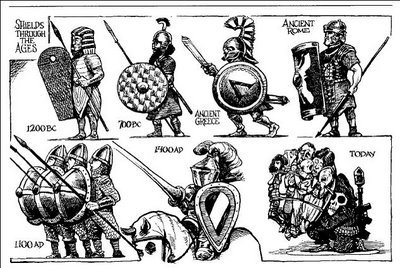
Shields


Figura da revista "The Economist", conseguida no blogue Serras.

Mais sobre Human Shields.

sexta-feira

The boy with the gun, David Sylvian

He knows well his wicked ways
A course of bitterness
A grudge held from his childhood days
As if life had loved him less
Reading down his list of names
He ticks them one by one
He points the barrel at the sky
Firing shots off at the sun
I am the law and I am the King
I am the wisdom, listen to me sing
He carves out the victim's names
In the wooden butt of the gun
He leans well back against the tree
He knows his Kingdom's come
He'll breath a sigh self satisfied
The work is in good hands
He shoots the coins into the air
And follows where the money lands
I am the law and I am the King
I am the wisdom, listen to me sing
He pauses at the city's edge
Of hellfire and of stone
He summons up the devil there
To give him courage of his own
He'll free the sinners of deceit
They'll hear his name and run
His justice is his own reward
Measured out beneath the sun
I am the law and I am the King
I am the wisdom, listen to me sing
And my name's on the gun

domingo

O ataque contra o Hezbollah...

... é como matar moscas com uma pistola.

Mas o que interessa é mostrar a pistola.

quinta-feira

O dejá vu da desgraça

Apesar de só ter falado de futebol, eu andei atenta aos jornais, para lá da secção desporto. Dei conta que o mundo não parou e as tragédias e desaires humanos continuaram. Na verdade, uma pessoa só fala de futebol porque é a única coisa realmente nova. Por exemplo, no Médio Oriente, Israel continua a reagir exageradamente, os palestinianos continuam o seu água mole em pedra dura tanto bate até que os israelitas vêm por aí abaixo e levam tudo a eito. Depois há os amigalhaços, eu mato aqui e tu matas ali e é o compadrio do desmembramento e do sangue jorrado. A sensação é de desalento. Isto vai-se resolver messianicamente. Um dia, algures no futuro, dois líderes hão-de ultrapassar barreiras de ódio e fazer compromissos inimagináveis. O Nobel da Paz ser-lhes-á despachado lá da Escandinávia e muitos editoriais laudatórios serão escritos. As pessoas hão-de comover-se, quererão desesperadamente alguma luz, seguirão quem quer que seja com carisma que lhes diga do fundo do túnel. A probabilidade disto eu não sei. É necessário que nasçam pela mesma altura e que não sejam, pelo caminho, mortos por extremistas. É necessário que eles sejam tão fora de série que até os extremistas chorem como carneirinhos. Até lá, é o dejá vu da desgraça. Até lá os palestinianos falam a língua da morte e os israelitas, consoante o que lhes convém, não querem falar ou fazem de conta que falam, falam quando já não há ninguém, falam com eles próprios e enquanto fazem a gincana do diálogo, constroem um muro e fazem raides. Eu, por mim, queria a tal alienação de um campeonato mundial de futebol.

quarta-feira

Guerra de 1948 na Palestina, designada pelos Israelitas como Guerra pela Independência, designada pelos Palestinianos como O Desastre

Numa primeira fase desenrolou-se entre os judeus e os árabes da Palestina e numa segunda fase entre Israel e os países árabes limítrofes. Nesta guerra criaram-se milhares de refugiados palestinianos, situação que se mantém até hoje. Os palestinianos foram desde então ignorados pelos israelitas (até às intifadas, em que foi impossível continuar o exercício de ignoranço) e utilizados pelos árabes como desculpa para as suas estratégias políticas. Por um lado aos países árabes desagradava-lhes ter como vizinho um país não árabe que consideravam uma nova força intrusa do Ocidente e, por outro lado, tinham pretensões territoriais à Palestina. Aos israelitas era preferível ver na sua história a luta de David (Israel) contra Golias (os estados árabes), do que a luta pelo mesmo território de dois povos: um povo autóctone e um povo imigrante, ambos incapazes de aceitar o outro.

segunda-feira

Conversa que surgiu da homenagem Lisboa 1506

Um amigo meu alemão resolveu pedir à avó que lhe permitisse ler as cartas que ela recebeu do marido durante e após a II Guerra Mundial. Um mergulho na história da Alemanha e dele. O avô foi um juiz bem sucedido no aparelho nazi. Foi preso pelo exército soviético e acabou por morrer numa das suas prisões. A avó fugiu com as filhas pela mão, numa grande caminhada de terror à frente do exército soviético, do que é hoje Polónia para o que é hoje a Alemanha. Nunca conseguiu falar desses momentos. Segundo o que ele me disse, o avô nunca assumiu nenhum mal na sua conduta. Ele tinha sido, na sua consciência, um homem responsável, honesto, que tinha feito o seu dever para com a pátria e a família. O meu amigo falou-me de um livro que andava a ler de um Sebastian Haffner, um alemão com um começo de vida quase a papel químico da do avô. A mesma cidade, bairros parecidos, a mesma escola, a mesma formação. Contudo, um fugiu para a Grã-Bretanha antes da guerra e o outro tornou-se nazi. "Porquê?", pergunta-se*. As minhas perguntas são outras. Disse-lhe: "Eu quero saber como era a Alemanha antes da guerra por alguém que o viveu. Achas que esse livro pode responder-me?". "Sim, penso que sim. Mas tens que ter umas luzes da história da Alemanha." Ok, wikipédia.

* Lembrou-me o filme "Capote". A certa altura Truman Capote, o escritor de renome, diz de Perry Smith, o assassino: It's as if Perry and I grew up in the same house. And one day he went out the back door and I went out the front.